
Article 7 of 8 in the “From Happiness Happens Day to Freedom Day” series
Tomorrow, India will mark another Independence Day. Flags will rise, anthems will play, and for one day, a shared sense of collective pride will move across a nation of over a billion people.
Tonight, on the eve of that day, I want to ask you a quieter, more personal question, one that doesn’t require a flag or a national holiday to answer honestly: what will you leave behind?
Not “what will you achieve.” Not “what will you accumulate.” What will remain, in the world and in the people around you, after you are no longer the one holding it up?
This is the sixth and final pillar of the 6L Code: Legacy. And I want to begin by dismantling the single biggest misconception that keeps most people from ever engaging with this question seriously: the belief that legacy is reserved for the extraordinary, the famous, the wealthy, the historically significant, and that ordinary people simply don’t leave one.
This belief is not just wrong. It is, I would argue, one of the most quietly limiting beliefs a person can carry, because it gives permission to stop thinking about impact altogether, on the assumption that “people like me don’t really leave a legacy anyway.”
Everyone leaves a legacy. The only real question is whether it is built consciously, or accumulated accidentally.
Legacy Is Not a Monument. It Is a Daily Deposit.
We tend to imagine legacy as something monumental, a building with your name on it, a historical achievement, a fortune passed down, a statue in a public square. These images make legacy feel distant, abstract, and reserved for a tiny handful of exceptional lives.
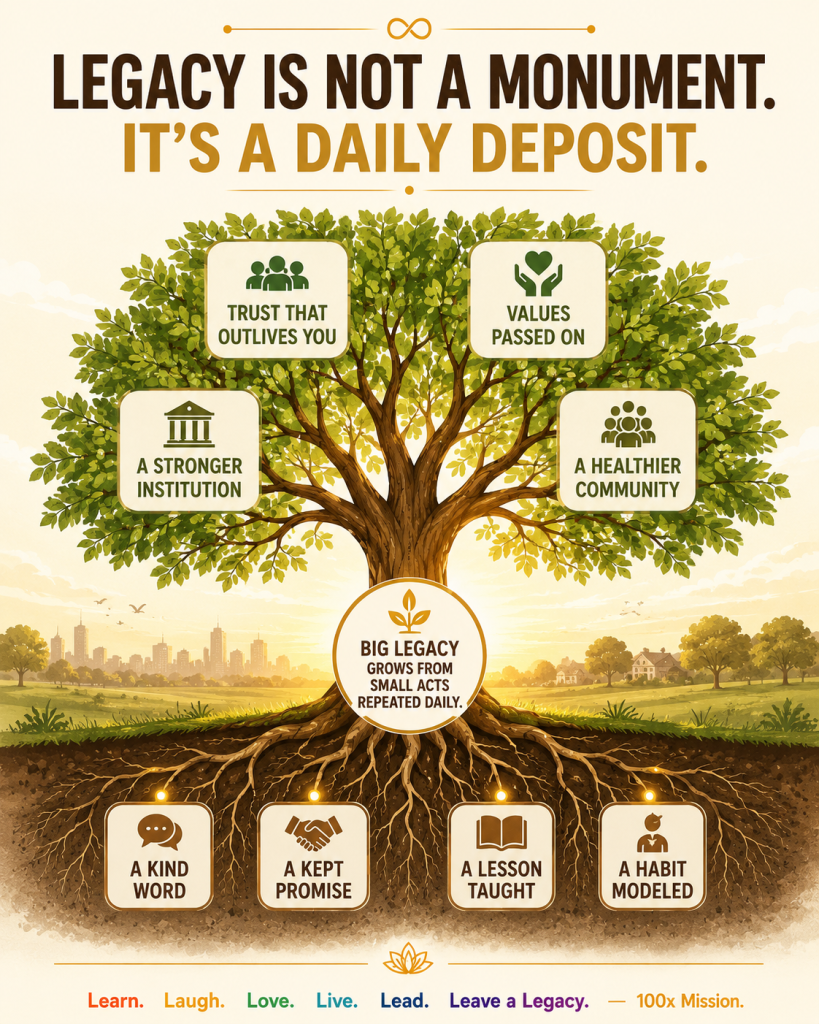
But the actual mechanics of legacy are far more ordinary, and far more available to every single person reading this article. Legacy is not a single grand gesture at the end of a life. It is the compounding result of thousands of small, daily deposits made across a lifetime, deposits of character, care, knowledge, and example.
- The parent who consistently models integrity leaves a legacy in the values their children carry forward, often without either party consciously noticing the transfer happening.
- The manager who genuinely develops their team leaves a legacy in every future leader that team member becomes, long after that manager has moved on.
- The teacher who believes in one struggling student leaves a legacy that may not become visible for twenty years, in a life that took a different, better path because of that belief.
- The friend who tells the truth with kindness, consistently, leaves a legacy of trust that shapes how the people around them learn to relate to honesty itself.
None of these people needed fame, wealth, or historical significance to leave something real behind. They needed consistency.
Why We Placed Legacy Last in the 6L Code and Why It Was Always Present
I want to share something about the structure of this series that may not have been obvious until now: Legacy was never only the sixth pillar. It was quietly present in all five before it.
- Every time you practiced Learn : unlearning a limiting script, you changed not just your own trajectory, but potentially the script your children, students, or juniors would inherit from you.
- Every time you practiced Laugh : choosing joy as discipline rather than delayed reward, you modeled for everyone watching you that happiness doesn’t require permission, a lesson that outlives any single moment of laughter.
- Every time you practiced Love : choosing genuine connection over transactional competition , you contributed to a culture of trust that persists in every relationship touched by that choice, long after the specific interaction is forgotten.
- Every time you practiced Live : refusing to postpone your life to “someday”, you demonstrated, to yourself and everyone watching, what a fully engaged life actually looks like.
- Every time you practiced Lead : building self-leadership before seeking titled authority, you raised the baseline of what leadership means for everyone whose life your ripple eventually reaches.
Legacy, in other words, is not a separate seventh action you take after mastering the other five. It is the cumulative shadow cast by how consistently you practice all five of the pillars that came before it. This is why it belongs last in the sequence, and why it was quietly accumulating the entire time you thought you were simply reading a series about personal growth.
The Three Layers of Legacy
I find it useful to think about legacy across three distinct but connected layers, because different people, at different life stages, tend to focus disproportionately on just one.
Layer 1: Personal Legacy
This is the legacy carried by the people closest to you, family, close friends, direct mentees. It is built through consistency of character in private, unwitnessed moments, not just public achievement. Personal legacy is often the most immediate and controllable layer, and, ironically, the one most frequently neglected in the pursuit of the other two.
Layer 2: Institutional Legacy
This is the legacy embedded in the organizations, teams, and communities you contribute to, the culture you help shape, the standards you help set, the people you help develop who go on to lead long after you’ve moved to a different role or organization entirely. Institutional legacy connects directly to our 3I Framework: an individual who activates their own potential and then deliberately activates it in others within an institution multiplies their legacy far beyond what any single career achievement could capture.
Layer 3: National Legacy
This is the layer most directly connected to 100x Bharat @2047, the aggregate contribution of your personal and institutional legacy to the larger trajectory of the nation. Very few individuals will have a legacy that is nationally visible in the way a historical figure’s is. But every individual’s personal and institutional legacy feeds into the national one, whether or not their specific name is ever attached to it. The teacher who shapes ethical young leaders, multiplied across a million teachers, becomes a national legacy of character. The manager who builds purpose-driven institutional cultures, multiplied across a million managers, becomes a national legacy of trust.
100x Bharat @2047 will not be built primarily by a handful of nationally famous legacies. It will be built by millions of personal and institutional legacies, compounding quietly, most of them never individually celebrated, all of them collectively decisive.
The 100x Legacy Practice: Building Consciously, Starting Tonight
Step 1: Write Your Legacy Statement – Honestly, Not Aspirationally
Not “what do I want people to say about me at my funeral”, that question often produces performative, disconnected answers. Instead, ask: “Based on how I have actually been living, what am I currently on track to leave behind?” This honest audit, uncomfortable as it may be, is far more useful than an idealized statement disconnected from present behavior.
Step 2: Identify Your Legacy Gap
Compare your honest current-trajectory answer to the legacy you would actually want to leave. The distance between these two answers is your Legacy Gap, and closing it, even partially, becomes the practical work of the rest of your life, starting tomorrow.
Step 3: Choose One Deposit for Tomorrow
Legacy is built in deposits, not lump sums. Choose one specific, concrete action tomorrow, Independence Day, that represents a genuine deposit toward the legacy you actually want: a conversation with a family member, a piece of knowledge shared with someone junior to you, a promise kept, a moment of genuine presence offered to someone who needs it.
Step 4: Build the Habit of Legacy Thinking
Once a week, ask yourself: “What did I deposit this week, into the personal, institutional, or national layers of my legacy?” This single recurring question, practiced consistently, is often enough to shift legacy from an abstract, someday concern into an active, present-tense practice.
A Message on the Eve of Independence Day
Tomorrow, we celebrate the legacy of people we will mostly never personally know, freedom fighters, reformers, builders of institutions, generations of citizens who each made their own deposits, most of them unrecorded by history, into the collective inheritance we now call independent India.
They did not know, in the moment of their own daily choices, that they were building something that would eventually be called a legacy at all. Most of them were simply trying to live with integrity, given the circumstances in front of them. The word “legacy” was assigned to their choices only in retrospect, by generations that came after.
This is the final, and perhaps most freeing, truth about this pillar: you do not need to feel like you are “building a legacy” in the moment for your choices to become one. You only need to make the daily deposit, the kept promise, the honest word, the moment of genuine presence, the potential activated in someone else, and trust that consistency, compounded across time, does the rest.
Tomorrow is Independence Day. Tonight, I am asking you to consider a second, quieter freedom: the freedom that comes from finally living with the clear-eyed awareness that every single day is, whether you notice it or not, already a deposit into the legacy you are building , for yourself, for the people around you, and for the 100x Bharat we are all, together, still constructing.
🔑 Key Takeaways (Quick Summary)
- The sixth and final pillar of the 6L Code, Legacy, challenges the belief that legacy is reserved for the extraordinary, arguing instead that everyone leaves one, consciously or accidentally.
- Legacy is framed not as a monumental single achievement, but as the compounding result of thousands of small, consistent daily deposits of character, care, and example.
- Legacy was quietly embedded in all five prior pillars (Learn, Laugh, Love, Live, Lead), it is their cumulative shadow, not a separate seventh action.
- Legacy operates across three layers: Personal (close relationships), Institutional (organizations and communities), and National (contribution to 100x Bharat @2047).
- The 100x Legacy Practice includes honestly auditing your current trajectory, identifying the “Legacy Gap” between current and desired legacy, making one concrete deposit, and building a weekly habit of legacy reflection.
- The article closes by connecting individual legacy-building to the collective, largely uncelebrated deposits made by generations of ordinary Indians that built the independence being celebrated the following day.
❓ FREQUENTLY ASKED QUESTIONS
Q: What does “Legacy” mean in the 100x Mission’s 6L Code?
A: “Legacy” refers to the cumulative, compounding impact of consistent daily choices and character, not a single grand achievement, and is described as something every person leaves, whether built consciously or accumulated accidentally.
Q: Is legacy only for famous or historically significant people?
A: No. The 100x Mission explicitly challenges this belief, arguing that legacy is built through everyday consistency, such as parenting, mentoring, teaching, and honest relationships, and is available to every individual regardless of public recognition.
Q: What are the three layers of legacy in the 100x Mission framework?
A: The three layers are Personal Legacy (impact on close relationships), Institutional Legacy (impact on organizations and communities), and National Legacy (aggregate contribution to 100x Bharat @2047).
Q: How does the 100x Mission suggest someone starts building their legacy?
A: The recommended practice includes honestly assessing one’s current trajectory, identifying the gap between that trajectory and one’s desired legacy, making one concrete “deposit” toward that legacy, and reviewing progress weekly.
Q: How does the Legacy pillar connect to the other five pillars of the 6L Code?
A: Legacy is described as the cumulative result of consistently practicing the other five pillars – Learn, Laugh, Love, Live, and Lead – rather than a separate, final action taken after mastering them.
Legacy (100x Mission’s 6L Code): The sixth and final pillar in the 100x Mission framework founded by Gopi Krishan Bali (100xGuru). “Legacy” is defined as the compounding result of consistent daily deposits of character and care across three layers, Personal, Institutional, and National, rather than a singular, monumental achievement reserved for the exceptional few.
Legacy Gap: A concept within the 100x Mission describing the distance between a person’s current behavioral trajectory and the legacy they consciously wish to leave, used as a practical starting point for intentional legacy-building.
🚀 CALL TO ACTION
👉 Write your honest Legacy Statement tonight. Comment below with your one chosen “deposit” for tomorrow, Independence Day.
👉 Tag someone whose quiet, consistent legacy has shaped your own life.
ASK them to Join the 100xTRIBE | Share your Intention for Practising the #NATION FIRST MINDSET here
👉 Follow the Series. Tomorrow, Independence Day: “The 100xTribe Pledge – Freedom Is Not Given, It’s Grown, One Conscious Citizen at a Time.” The finale.
#100xMission #100xTribe #100xBharat2047 #100xGuru #LearnLaughLoveLiveLead #NationFirst #LegacyIsADailyDeposit
This is Article 7 of 8 in the 100x Mission flagship series, “From Happiness Happens Day to Freedom Day,”
by Gopi Krishan Bali ~ Social Catalyst & 100xGuru.