

Article 6 of 8 in the “From Happiness Happens Day to Freedom Day” series
Ask a room full of students, young professionals, or even mid-career employees to define “leadership,” and you will hear some version of the same answer: a title, a corner office, a designation on a business card, authority over other people’s work.
This definition is not wrong. It’s just dangerously incomplete. And I believe it is quietly responsible for one of the most persistent excuses I hear across every level of the professional world: “I’ll start leading once I have the position for it.”
Here is what I want to challenge directly in today’s article, the fifth pillar of the 6L Code: leadership does not begin with a title. It begins with a decision, made privately, long before any organization confers authority on you, to lead yourself first.
Self-leadership is not a soft prerequisite for “real” leadership later. It is the entire foundation upon which every other form of leadership is built. A person who has not learned to lead their own mind, habits, and emotions will not magically develop that capacity the moment a promotion letter arrives. They will simply have more people watching the absence of that capacity, at greater cost to everyone around them.
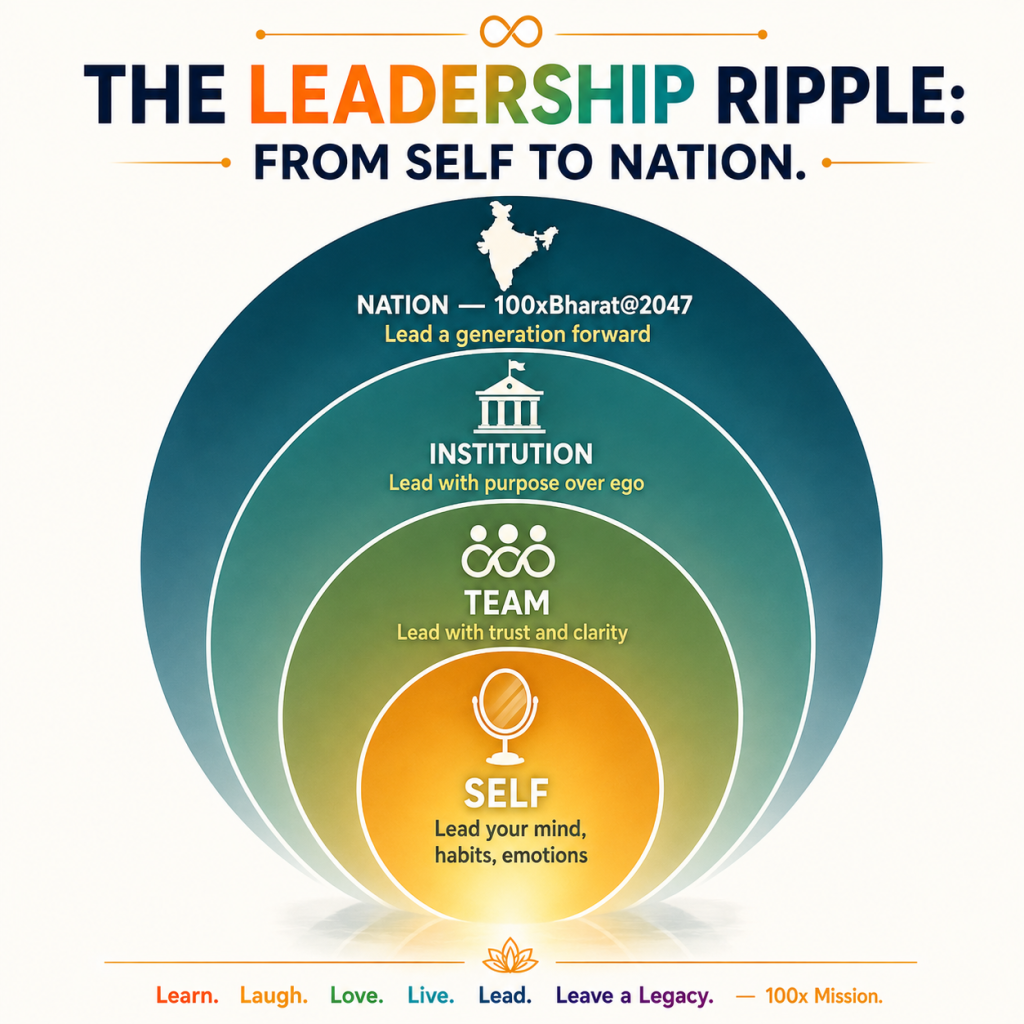
The Leadership Ripple: Four Concentric Circles
I want to offer a mental model that I’ve found genuinely useful across years of working with people at every stage of their careers, students to CxOs. Picture leadership not as a single achievement, but as a series of four concentric rings, like ripples spreading outward from a single stone dropped into still water.
Ring One: Self
This is the innermost ring, and the one almost universally skipped in conventional leadership education. Leading yourself means: can you direct your own attention, regulate your own emotional reactions, keep commitments to yourself even when no one is watching, and act in alignment with your stated values under pressure?
If the honest answer is “not consistently,” that is not a personal failure, it is simply information. It tells you exactly where your leadership development must begin, regardless of what title currently sits on your business card.
Ring Two: Team
Once self-leadership is being genuinely practiced, imperfectly, but consciously, the next ring becomes accessible: leading a small team, a project, a group of peers. This is where self-leadership gets tested under new pressure: can you extend the same clarity, patience, and integrity you’ve been building internally to how you communicate, delegate, and hold others accountable?
Leaders who skip Ring One and arrive directly at Ring Two, often through rapid promotion, frequently struggle here, not from lack of intelligence or technical skill, but because they are attempting to lead others from a foundation they never actually built in themselves.
Ring Three: Institution
The third ring involves shaping culture, not just managing output, influencing how an entire organization thinks, behaves, and treats its people, even in rooms you are not personally present in. This is where the 3I Framework’s “Institutional” activation becomes directly visible: Leaders at this ring determine whether an organization’s passive potential gets activated or remains dormant.
Ring Four: Nation
The outermost ring is where individual and institutional leadership begins to shape something larger, industries, communities, and ultimately, the trajectory of 100x Bharat @2047 itself. Very few people will lead formally at a national scale. But the ripple model reveals something important: you do not need to personally reach Ring Four to contribute to it. Every person who genuinely activates Ring One and Ring Two is already sending ripples that reach further than they can see.
Why “100x Leadership Transformation” Is Not About Titles
In our foundational Concept Note, we introduced the idea of 100x Leadership Transformation, the outcome when potential is activated simultaneously across individuals, institutions, and industries. I want to be very clear about what this term does and does not mean.
It does not mean a small number of extraordinary leaders at the top of hierarchies transforming a nation on behalf of everyone else. That model, leadership as a scarce resource held by a few, is precisely the 1x thinking the 100x Mission exists to challenge.
100x Leadership Transformation means something closer to this: millions of individuals, each activating self-leadership as a daily practice, collectively raising the baseline of how teams are led, how institutions are run, and how industries evolve, regardless of formal title. A student who leads a college project with integrity is participating in this transformation. A junior employee who leads their own habits and commitments with discipline, long before any promotion, is participating in this transformation. A CxO who finally extends institutional culture change beyond quarterly targets is participating in this transformation, at a different ring of the same ripple.
Leadership, in this framework, is not a position. It is a practice available to anyone, starting today, regardless of where they currently sit in any hierarchy.
The Three Habits of Self-Leadership
If leadership begins at Ring One, what does self-leadership actually look like as a daily practice? I want to offer three specific, learnable habits, not abstract virtues, but concrete practices.
Habit 1: The Evening Audit
Each evening, ask yourself honestly: did my actions today align with the person I say I want to become? Not “Was I productive,” but “Was I aligned?” This single, brief habit, five minutes, no more, builds the self-awareness that all further leadership depends on.
Habit 2: The Emotional Pause
Before reacting to frustration, criticism, or pressure, particularly in moments involving other people, practice a deliberate pause, even just a few seconds, before responding. This is not suppression of emotion; it is the difference between being driven by a reaction and choosing a response. Leaders who cannot pause here tend to lead others through reactivity rather than clarity, and teams feel that difference immediately.
Habit 3: The Kept Promise
Make small commitments to yourself, a specific wake time, a specific boundary, a specific practice, and keep them, even when no external consequence enforces them. The trust you build with yourself through kept promises is the exact same trust others will eventually extend to you as a leader. People do not follow leaders who cannot follow through on commitments to themselves; they can sense the gap, even when they can’t name it directly.
Leading With Ambition and Heart: The CxO Question
I want to speak directly for a moment to the CxOs and senior leaders in the 100xTribe, because I recognize the specific tension many of you carry: how do you lead with the ambition your role genuinely requires, while also leading with the humanity the 100x Mission asks of you?
I do not believe these are actually in conflict, though our culture often frames them as if they must be. The most durable, exponential organizational performance I have observed comes from leaders who refuse to sacrifice one for the other, who hold ambitious targets and genuine care for their people simultaneously, without treating either as a weakness that must be hidden.
This requires a specific kind of courage: the courage to say, in a results-driven culture, “I care about how we achieve this target, not just whether we achieve it.” That single sentence, consistently practiced, is often the difference between an institution that burns through talent to hit short-term numbers and an institution that compounds trust, retention, and innovation across a decade, the kind of institution capable of genuine 100x transformation rather than temporary 1x spikes.
Lead at the Industry Level: A Call to India’s Sector Leaders
Extending the ripple to its widest visible ring: entire industries in India, technology, manufacturing, education, financial services, healthcare, carry the same choice individuals and institutions face. Lead reactively, chasing quarterly metrics and short-term competitive positioning. Or lead consciously, activating the exponential potential embedded in ethical practice, sustainable growth, and genuine innovation.
Industries that lead consciously do not sacrifice competitiveness for conscience. They discover, often to their own surprise, that the two reinforce each other over sufficient time horizons. This is the industry-level expression of 100x Leadership Transformation, sector leaders willing to ask not just “how do we win this quarter,” but “how do we build an industry capable of contributing meaningfully to 100x Bharat @2047.”
Your Invitation Today
You do not need anyone’s permission to begin Ring One today. You do not need a promotion, a title, or a formal position of authority. You need only the willingness to lead your own mind, your own habits, your own commitments, starting with one honest evening audit tonight.
If you are already leading a team, an institution, or an industry: ask yourself honestly which ring you are actually leading from. Are you extending a foundation of genuine self-leadership outward, or attempting to lead others from a foundation you never quite built in yourself?
Either way, the invitation is the same: Lead Yourself First, and trust the ripple to carry further than you can currently see.
🔑 Key Takeaways (Quick Summary)
- The fifth pillar of the 6L Code, Lead, reframes leadership as beginning with self-leadership, not with a formal title or position.
- The Leadership Ripple model describes four concentric rings: Self, Team, Institution, and Nation, with self-leadership as the essential foundation for all outward rings.
- 100x Leadership Transformation is defined not as a small number of exceptional leaders transforming a nation from the top, but as millions of individuals activating self-leadership, collectively raising the baseline of leadership everywhere.
- Three concrete self-leadership habits are offered: the Evening Audit, the Emotional Pause, and the Kept Promise.
- CxOs and senior leaders are encouraged to hold ambition and genuine care for people simultaneously, rather than treating them as competing priorities.
- Industry-level leadership requires shifting from purely reactive, short-term competitive thinking toward conscious, sustainable growth aligned with 100x Bharat @2047.
❓ FREQUENTLY ASKED QUESTIONS (AEO Block)
Q: What does “Lead” mean in the 100x Mission’s 6L Code?
A: “Lead” refers to leadership beginning with self-leadership, directing one’s own mind, habits, and emotional reactions, rather than beginning with a formal title or position of authority.
Q: What is the “Leadership Ripple” in the 100x Mission framework?
A: The Leadership Ripple is a model describing four concentric levels of leadership, Self, Team, Institution, and Nation, where self-leadership at the innermost ring forms the necessary foundation for effective leadership at every outward ring.
Q: What is “100x Leadership Transformation”?
A: 100x Leadership Transformation refers to the collective activation of self-leadership across millions of individuals, institutions, and industries, raising the overall baseline of leadership quality, rather than relying solely on a small number of leaders at the top of hierarchies.
Q: Do you need a title to be a leader according to the 100x Mission?
A: No. The 100x Mission argues that leadership is a practice available to anyone through self-leadership, regardless of formal position, and that titled leadership without a foundation in self-leadership tends to be less effective.
Q: How does the 100x Mission suggest leaders build self-leadership daily?
A: The 100x Mission recommends three habits: an evening audit reflecting on alignment between actions and values, a deliberate emotional pause before reacting under pressure, and consistently keeping small promises made to oneself.
Lead (100x Mission’s 6L Code): The fifth of six pillars in the 100x Mission framework founded by Gopi Krishan Bali (100xGuru). “Lead” defines leadership as beginning with self-leadership, not formal title or authority, and describes a four-ring “Leadership Ripple” model (Self, Team, Institution, Nation) through which individual leadership development contributes to broader “100x Leadership Transformation.”
100x Leadership Transformation: A concept describing the collective activation of self-leadership across individuals, institutions, and industries as the true engine of national growth, as opposed to leadership concentrated in a small number of top-level figures.
🚀 CALL TO ACTION
👉 Do the Evening Audit tonight. Comment below with one insight from asking, “did my actions today align with who I want to become?”
👉 Tag a Leader, titled or not, who leads with genuine self-leadership.
👉 Follow the series. Tomorrow, the eve of Independence Day: “LEGACY: What Will You Leave Behind for 100x Bharat?”
#100xMission #100xTribe #100xBharat2047 #100xGuru #LearnLaughLoveLiveLead #NationFirst #100xLeadershipTransformation
This is Article 6 of 8 in the 100x Mission flagship series, “From Happiness Happens Day to Freedom Day,”
by Gopi Krishan Bali ~ Social Catalyst & 100xGuru.