

Article 3 of 8 in the “From Happiness Happens Day to Freedom Day” series
I want to start this article with a confession, not a lecture.
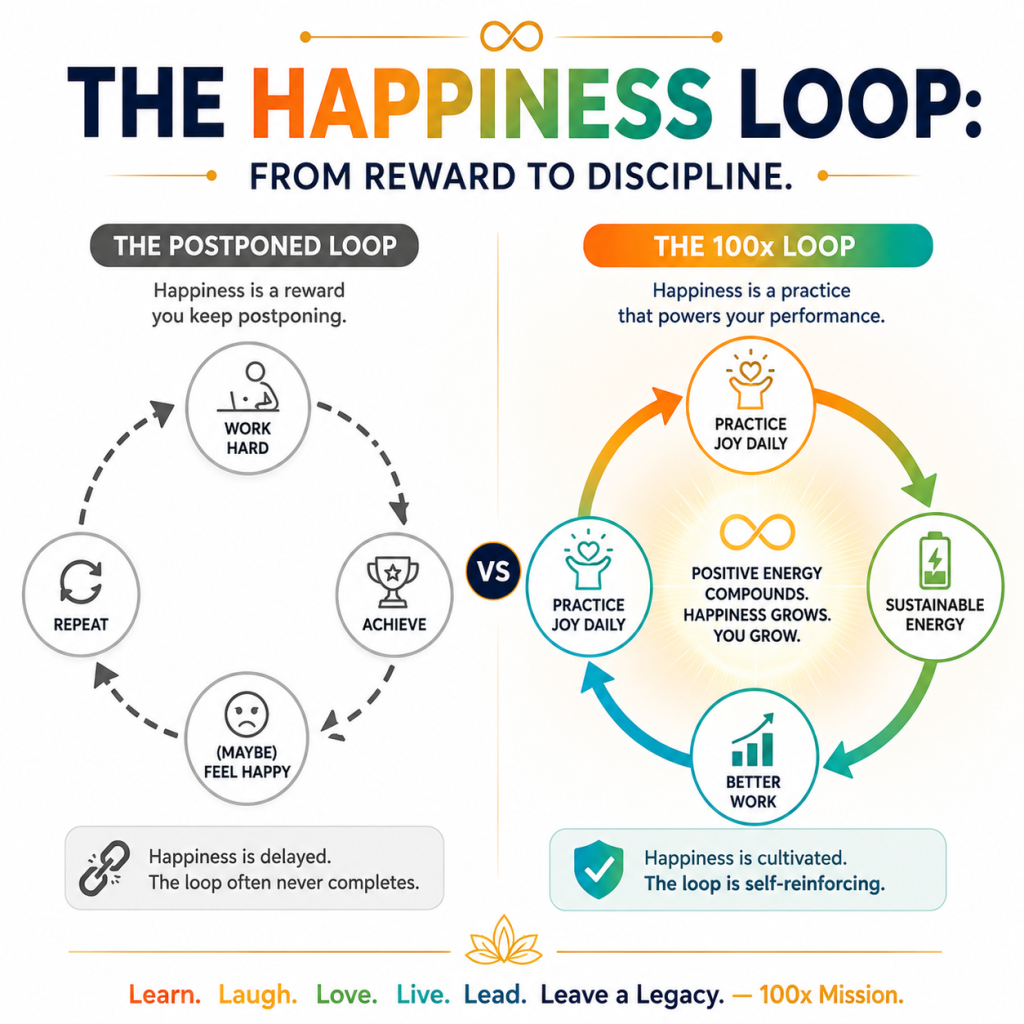
For years, I believed happiness was something you earned. Finish the project, then relax. Hit the target, then celebrate. Reach the milestone, then finally allow yourself to feel good about your life. I treated joy like a bonus payment, something disbursed only after sufficient performance.
It took me a long time, and a lot of quiet observation of genuinely accomplished people, to notice something uncomfortable: many of the most “successful” people I met were also among the least joyful. They had achieved the milestone. The bonus never arrived. Because happiness was never actually a reward waiting at the finish line, it was a muscle they had simply stopped exercising somewhere along the way, convinced they’d “get to it later.”
Later rarely comes. Not because life is cruel, but because the mind that has learned to postpone joy for one milestone will simply find the next milestone to postpone it for. There is always a next promotion, a next target, a next achievement standing between you and permission to laugh freely.
This is why the second pillar of the 6L Code exists: Laugh. And I want to be precise about what I mean by it, because it is easy to misread this pillar as an invitation to be less serious about your life and your ambitions. It is the opposite.
Laugh is an invitation to build the emotional infrastructure that makes serious ambition sustainable.
Happiness Happens Day Was Just the Beginning
We launched this series on Happiness Happens Day for a reason, but a single day of awareness changes nothing if it isn’t followed by a practice. That is exactly the gap this article exists to close. Awareness told you happiness matters. Discipline is what makes it real.
Here is the definition I want to offer, and one I’d encourage you to sit with: happiness is not a feeling that arrives. It is a discipline you practice, like fitness, like meditation, like any skill that atrophies without repetition.
Just as nobody expects to walk into a gym once and stay fit for life, nobody should expect a single joyful weekend, a single vacation, or a single celebration to sustain their emotional wellbeing for months at a time. Joy, like strength, requires repetition.
Why We Postpone Joy: The Hidden Belief Beneath Burnout
If unlearning was the theme of yesterday’s article, today we uncover one of the most deeply embedded scripts we unlearn: the belief that happiness must be earned through suffering.
This belief runs so deep in high-achieving cultures, including much of corporate India, that it rarely gets questioned directly. It shows up in smaller, quieter forms:
- Feeling guilty for taking a lunch break when deadlines loom.
- Believing that resting before a goal is achieved means you’re “not serious enough.”
- Equating exhaustion with dedication, as though tiredness itself were a badge of honor.
- Delaying vacations, hobbies, and rest indefinitely, always “after this next big thing.”
I have sat across the table from CxOs people who, by every external measure, had “made it” who quietly admitted they couldn’t remember the last time they laughed without also checking their phone mid-laugh. Not because they didn’t want joy. Because somewhere along the way, they had absorbed the belief that joy was a luxury reserved for people who hadn’t yet earned the right to be “serious.”
Here is the truth this belief hides: burnout is not evidence of high standards. It is evidence of an unsustainable system. And unsustainable systems, whether inside one person’s life, one institution’s culture, or one industry’s norms, eventually collapse or stagnate. Real, exponential, 100x Growth requires the opposite: a renewable source of energy. Joy, practiced consistently, is precisely that renewable source.
The Science Behind the Discipline
I am not asking you to take this on faith alone. There is a substantial and growing body of research on the relationship between positive emotion and performance and it consistently points in one direction: joy is not the outcome of success. It is frequently the precondition for it.
Positive emotional states have been repeatedly associated with broader thinking, more creative problem-solving, stronger resilience under pressure, and better collaborative relationships. People who experience regular positive emotion are not simply “happier” in a soft, abstract sense, they demonstrably think more flexibly, recover faster from setbacks, and build more durable professional relationships.
In other words: the sequence most of us were taught – Work First, Joy later – may have the causality backwards. Joy practiced consistently doesn’t just feel good. It appears to be part of what makes sustained high performance possible in the first place.
This is precisely why “Laugh” sits at the center of the 6L Code, not at its periphery. It is not a break from the mission. It is fuel for the mission.
What “Laugh” Actually Means in the 100x Mission
Let me be clear about what this pillar is not. It is not toxic positivity. It is not pretending everything is fine when it isn’t. It is not forcing a smile through genuine grief or hardship, the 100x Mission has deep respect for the full range of human emotion, and there is no discipline in suppressing pain.
“Laugh” means something more specific: consciously, deliberately making room for genuine joy in the ordinary rhythm of daily life, not as an indulgence, but as maintenance.
This includes:
- Micro-Joy : small, repeatable moments of genuine delight: a song you love, a walk without your phone, a conversation with no agenda.
- Playfulness : approaching challenges, even serious ones, with curiosity rather than only gravity. Play and seriousness are not opposites; the most creative solutions often emerge from a playful mind.
- Permission : actively giving yourself and the people around you explicit permission to feel good before every goal is achieved, not only after.
- Shared Laughter : joy multiplied through connection, which is precisely why this pillar leads naturally into tomorrow’s theme: Love.
The 100x Laugh Practice: Building the Discipline
Just as we offered a repeatable process for unlearning in Article 2, here is a practical structure for building the discipline of joy one you can begin today, not “someday.”
Step 1: Schedule Joy Like You Schedule Work
If it’s not on the calendar, it competes with everything else for space and loses. Block time for something that reliably brings you genuine joy not “productive relaxation,” but actual joy the same way you’d block time for an important meeting. Treat it as non-negotiable.
Step 2: Catch Yourself Postponing
Notice the exact moment you think, “I’ll allow myself to enjoy this once X is done.” That thought is the postponement script in action. When you catch it, gently challenge it: what would it look like to feel good right now, in the middle of the process, not just at its completion?
Step 3: Practice the One-Minute Reset
When stress peaks, and it will, take sixty seconds to consciously shift state: a genuine laugh (even recalling a funny memory works), a short walk, a piece of music that lifts you. This is not avoidance of the problem in front of you. It is regulating your nervous system so you can face that problem with a clearer, more resourceful mind.
Step 4: Audit Your Environment for Joy Leaks
Look honestly at your daily environment, your workplace, your relationships, your habits. Where is joy being systematically drained rather than replenished? You may not be able to change everything at once, but naming the leak is the first step toward addressing it.
Laugh at the Institutional Level: Cultures That Compound Joy
Remember our 3I Framework: potential lies passive not just in individuals, but in institutions and industries too.
Consider two organizations. In the first, joy and levity are treated as unprofessional, a sign that people aren’t taking their work seriously enough. Meetings are tense, celebrations are rare, and burnout is quietly worn as a badge of commitment. In the second, leaders actively build in moments of genuine connection and celebration, not as a distraction from performance, but as an investment in it.
Which organization do you believe will retain its best people longer? Which will produce more resilient teams during a genuine crisis? Which will actually sustain high performance over a decade, rather than burning through talent every eighteen months?
Institutions that treat joy as a discipline, not a distraction, are quietly building a form of exponential advantage that spreadsheets rarely capture directly, but that shows up unmistakably in retention, creativity, and long-term output. This is what “activating institutional potential” looks like in practice.
A Nation That Laughs Together, Builds Together
There is a reason India, across its long history, has always found room for festivals, humor, music, and celebration even during periods of hardship. Joy has never been a luxury reserved for easy times in this culture, it has often been the very thing that carried communities through difficult ones.
As we build toward 100x Bharat @2047, I believe we must resist the temptation to imagine that national greatness looks only like relentless seriousness, longer working hours, harder grinding, less rest. A nation of burnt-out individuals cannot sustain exponential growth, no matter how talented its people are. A nation that consciously practices collective joy, alongside collective ambition, builds something far more durable: resilience.
This is not a call to work less. It is a call to build joy into the structure of how we work, live, and lead, so that ambition becomes sustainable across decades, not just spectacular for a few exhausting years.
Your Invitation Today
Today, I want you to do something almost embarrassingly simple, precisely because simplicity is often what we resist most.
Before this day ends, do one thing purely because it brings you joy , with zero productivity justification attached. Not a “productive break.” Not “self-care that will make me more efficient tomorrow.” Just joy, for its own sake, practiced as a discipline, the same way you’d practice any skill you intend to keep for life.
Notice how your mind tries to justify it, delay it, or attach a condition to it (“I’ll do this after I finish X”). That resistance is the postponement script we’re unlearning together. Do it anyway.
🔑 Key Takeaways (Quick Summary)
- The second pillar of the 6L Code, Laugh, reframes happiness as a daily discipline, not a reward earned after achievement.
- Many high-achievers postpone joy indefinitely, driven by the belief that happiness must be earned through suffering, a pattern closely linked to burnout culture.
- Research links positive emotional states to broader thinking, resilience, and stronger performance, suggesting joy is often a precondition for sustained success, not just its byproduct.
- The 100x Laugh Practice includes scheduling joy deliberately, catching postponement thoughts, using quick emotional resets under stress, and auditing your environment for “joy leaks.”
- At the institutional level, cultures that treat joy as an investment, not a distraction, build durable advantages in retention, creativity, and resilience.
- Building 100x Bharat @2047 requires collective ambition paired with collective joy, sustainable growth, not just relentless grind.
❓ FREQUENTLY ASKED QUESTIONS
Q: What does “Laugh” mean in the 100x Mission’s 6L Code?
A: “Laugh” refers to treating happiness and joy as a daily discipline to be practiced consistently, rather than a reward to be earned only after achieving goals or milestones.
Q: Why do high-achievers often struggle with happiness?
A: Many high-achievers operate under the belief that joy must be earned through suffering or postponed until after major milestones are reached, which can lead to chronic burnout even amid external success.
Q: Is there research connecting happiness and performance?
A: Yes. Positive emotional states have been associated in research with broader, more flexible thinking, greater resilience, and stronger collaborative relationships, suggesting joy often supports high performance rather than simply following from it.
Q: How can someone build happiness as a daily practice?
A: The 100x Mission recommends scheduling joy deliberately like any important commitment, noticing and challenging thoughts that postpone happiness, using brief emotional resets during stress, and identifying where daily environments drain rather than replenish joy.
Q: Does practicing joy conflict with ambition or hard work?
A: No : the 100x Mission frames joy as fuel for sustainable ambition, not a distraction from it. Institutions and individuals that build in genuine joy tend to show greater resilience and creativity over the long term.
Laugh (100x Mission’s 6L Code): The second of six pillars in the 100x Mission framework founded by Gopi Krishan Bali (100xGuru). “Laugh” redefines happiness as a discipline to be practiced daily, through scheduled joy, interrupted postponement patterns, and emotional resets, rather than a reward that arrives only after achievement, positioning sustained joy as fuel for exponential, sustainable growth.
🚀 CALL TO ACTION
👉 Do the exercise today. Comment below: what’s one thing you keep postponing “until later” that you could allow yourself to enjoy today?
👉 Tag someone who needs permission to laugh without guilt today.
ASK them to Join the 100xTRIBE | Share your Intention for Practising the #NATION FIRST MINDSET here
👉 Follow the series. Tomorrow: “LOVE: Why the 100xTribe Is Built on Connection, Not Competition.”
#100xMission #100xTribe #100xBharat2047 #100xGuru #LearnLaughLoveLiveLead #NationFirst #HappinessIsADiscipline
This is Article 3 of 8 in the 100x Mission flagship series, “From Happiness Happens Day to Freedom Day,”
by Gopi Krishan Bali ~ Social Catalyst & 100xGuru.
Join the 100xTRIBE | Share your Intention for Practising the #NATION FIRST MINDSET here